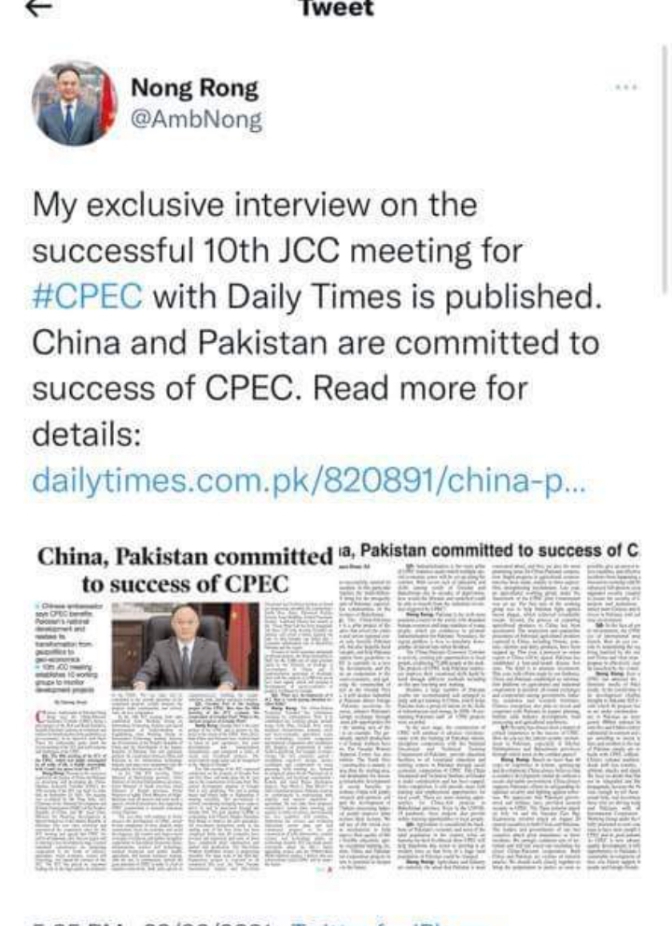
Chinese Ambassador to Pakistan Nong Rong says the China-Pakistan Economic Corridor (CPEC), being a pilot project of the Belt and Road Initiative, benefits Pakistan’s national development and realises its transformation from geopolitics to geo-economics. In an interview with Daily Times, the ambassador spoke about the recent meeting of the JCC and achievements and challenges of the CPEC.
Q2: Gwadar Port is the leading project of the CPEC. How does the 10th meeting of the JCC evaluate the cooperation of Gwadar Port? What is the current progress of Gwadar Port?
Nong Rong: Gwadar Port is the pilot project of the CPEC and is known as the jewel in the crown of the CPEC. Since 2013, both China and Pakistan have worked hand in hand on port operations, free zone development, and transportation infrastructure, and completed a series of social and livelihood projects. The achievements made today can be recognized as the “Speed of Gwadar”.
The 10th meeting of the JCC expressed satisfaction on the progress of Gwadar Port and Free Zone, and made plans for the next step in the construction of Gwadar Port. The current development situation of Gwadar Port is very gratifying. The port is getting busier and transit trade to Afghanistan is running smoothly. The government is actively considering arranging more cargo to arrive in and be processed through the Gwadar Port. The port operator COPHC is cooperating with China’s Ningbo Zhoushan Port Group to improve the port operations. All investment promotion work in the starting zone of the Free Zone has been completed. More than 40 companies have invested and registered, and some of them have completed plant construction and started trial production. The Pak-China Products Exhibition Center is progressing smoothly. The main work of the East Bay Expressway project is expected to be completed this year, the New Gwadar International Airport and Pak-China Vocational and Technical Institute at Gwadar are progressing smoothly, the construction of North Free Zone, Chemical Fertilizer Factory, Expo Building, Animal Vaccination Factory, Lubricant Factory has started, and the Tissue Plant Lab has been inaugurated. All these will help develop Gwadar’s port industry and create a future regional trade hub, so that Gwadar can better play its economic radialization role in Balochistan, Pakistan and the region.
In terms of social-economic and people’s livelihood projects, the Solar Generators Aid MoU for the 5,000 sets of solar generators aided by the Ministry of Ecology and Environment of China and the implementation agreement of desalination plant with the capacity of 5,000 tons per day have been signed, which will promote the development of social-economic and people’s livelihood in Gwadar.
Q3: What new developments of the JCC that is worth paying attention to in other fields?
Nong Rong: The China-Pakistan Economic Corridor has continuously enriched its connotations. Now it has established ten working groups including Long Term Plan, Gwadar Port, energy, transport infrastructure, industry, society and socio-economic, agriculture, science and technology, security cooperation, international cooperation and coordination. The progress of cooperation in various fields is gratifying. For example, in terms of energy, the two countries agreed to strengthen top-level design, promote exchanges and cooperation in energy planning, skills training, etc., formulate development plans for the Pakistani oil and gas industry, and accelerate construction of Kohala and Azad Pattan Hydropower projects, Thar Block-1, Thar Block-1 and other important projects. Pakistan expressed its commitment to maintaining policy stability and market regulation. In agriculture, the two sides have proposed a cooperative action plan covering eight aspects; in terms of science and technology, the two countries will continue to implement the science and technology innovation action plan and make continuous progress in the joint construction of joint laboratories, construct science and technology parks, and technology transfer. JCC has made positive statements about the ML-1 railway upgrading project and the N50(D.I.Khan-Zhob) highway project. I believe that more achievements under CPEC will be made in the future.
Q4: The CPEC has successfully entered its second phase of execution. In this particular phase, what opportunities the multi-billion-dollar initiative will bring for the prosperity of the common people of Pakistan, especially the downtrodden communities of the under-developed province of Balochistan.
Nong Rong: The China-Pakistan Economic Corridor is a pilot project of the Belt and Road Initiative that covers the entire territory of Pakistan and serves regional connectivity. CPEC not only benefits Pakistan national development, but also benefits local provinces and local people, and help Pakistan realize its transformation from geopolitics to geoeconomics. CPEC is currently in a new stage of high-quality development, and the next step will focus on cooperation in the fields of industry, socio-economic, and agriculture. By advancing the construction of industrial parks such as the Gwadar Free Zone and Rashakai, it will deepen industrial cooperation to help Pakistan attract foreign investment, help Pakistan accelerate its industrialization process, enhance Pakistan’s capacity to earn foreign exchange through exports, and create more job opportunities for local people. Take the starting area of the Gwadar Free Zone as an example. The garment factory has already started production and a large number of female workers have been hired to work. The Gwadar Women Employment Development Center has also been put into operation. The North Free Zone, of which the construction is started, is 36 times larger in area than the starting area, and is already a good destination for investment, and will bring remarkable development opportunities and social benefits to Balochistan. In agriculture, China will jointly with Balochistan research and promote soil improvement, support the development of local livestock and fishery processing industries, and help local people improve labor productivity and increase their income. We will also make good use of the social economic cooperation mechanism to help Pakistani people improve their quality of life through projects in flexible education, agriculture, medical care, vocational training, etc. In mining cooperation, China and Pakistan have existing mineral cooperation projects in Balochistan, and there is potential to deepen mining cooperation in the future.
Q5: Industrialization is the main pillar of CPEC initiative under which multiple special economic zones will be set up along the corridor. With severe lack of education and skills among youth of Gwadar and Balochistan due to decades of deprivation, how would the illiterate and unskilled youth be able to benefit from the industrial revolution triggered by CPEC?
Nong Rong: Pakistan is the sixth most populous country in the world, with abundant human resources and large numbers of young people, which are conducive to promote industrialization for Pakistan. Nowadays, the urgent problem is how to transform demographic dividend into talent dividend.
The China-Pakistan Economic Corridor is actively creating job opportunities to local people, employing 75,000 people at the peak. The projects of CPEC help Pakistan employees improve their vocational skills hand by hand through different methods including on-the-spot teaching and training.
Besides, a large number of Pakistan youths are recommended and arranged to study and get training in China, which helps Pakistan train a group of talents in the fields of infrastructure and energy. In 2020, 18 outstanding Pakistani staff of CPEC projects were awarded.
In the next stage, the construction of CPEC will continue to advance simultaneously with the training of Pakistani talents, strengthen cooperation with the National Vocational and Technical Training Commission of Pakistan, provide education facilities to all vocational education and training centers in Pakistan through social economic cooperation of CPEC. Pak-China Vocational and Technical Institute at Gwadar is under construction and has been capped. After completion, it will provide more skill training and employment opportunities for local youth. There are some training opportunities for China-Aid projects in Balochistan province. Even in the COVID-19 pandemic, these projects also provide online training opportunities to local People

